
My top 29 multi-channel e-commerce software comparison | 2026
.png)
I tested inventory uploading, bulk editing, and auto-delisting across 57 multi-channel e-commerce platforms like Amazon and eBay using real listings.
Sellbrite suits small sellers on Amazon, eBay, and Shopify, while Rithum fits enterprise brands across 400+ marketplaces. Nifty is the top pick for resellers who want crosslisting, automation, auto-delisting, and marketplace compliance. Extensiv handles mid-market warehouse routing.
These 29 tools stood out for preventing duplicate sales and actually saved time rather than creating more admin work.
29 best multi-channel e-commerce software comparison
How I tested these multi-channel e-commerce software platforms
I started with 57 multi-channel e-commerce software platforms and connected them to my existing accounts on Amazon, eBay, Poshmark, and Shopify. By listing T-shirts, hoodies, phone cases, and sportswear, I evaluated these factors:
- Real-time inventory updates across platforms: Accurate stock counts prevent overselling and angry customers. I created listings on eBay, Poshmark, and Mercari, then monitored how quickly each tool updated inventory after simulated sales.
- Bulk listing and editing capabilities: Managing hundreds of items one by one kills productivity and momentum. I uploaded 50 identical products across multiple marketplaces using each platform’s bulk tools, tracking time spent and error rates.
- Auto-delisting and sold item detection: Nothing's worse than selling the same item twice and having to issue refunds. I tested how each platform handled sales by marking items as sold on one marketplace and checking if they automatically delisted from others.
I also assessed these factors:
- Platform-specific automation rules and compliance: Each marketplace has different sharing limits, relisting cycles, and promotional rules. I tested whether the software adhered to these rules, such as Poshmark's 8,000 daily share limit and 60-day relist minimum.
- Profit tracking and fee calculations: Knowing your sale price means nothing if you can't calculate actual profit after platform fees, shipping, and cost of goods. I ran test sales through each tool and checked if analytics automatically deducted marketplace fees.
SMB multi-channel inventory
1. Sellbrite: Best for small multichannel sellers

What it does: Sellbrite centralizes listings and orders across marketplaces into one panel, removing manual platform logins and updates.
Best for: Smaller sellers managing a few dozen monthly listings and orders across channels, with room to scale.
I tested Sellbrite’s listing creation across Shopify, eBay, Amazon, and Walmart with identical SKUs for my phone cases. Delays occurred only when marketplaces reported errors, and Sellbrite logged mismatches clearly.
When I tested order routing, I found that the system kept orders aligned with shipping rules and auto-notified customers directly. That steadied fulfillment on peak days and cut support tickets.
Key features
- Unified listing control: Pushes edits across marketplaces from one dashboard without repetitive work.
- Order consolidation view: Shows all channel orders in one scrollable queue for quicker processing.
- Marketplace rule support: Applies channel limits so shipments reflect each store’s standards.
Pros
- Reduces login switching: All marketplace accounts are managed in a single interface, helping reduce repetitive logins.
- Stops stock mismatches: Automated updates keep counts aligned as orders arrive.
Cons
- Update lag can cause oversells: Some users have reported overselling issues when using tools like Sellbrite alongside Shopify, Amazon, and Etsy, especially when channel inventory updates are not truly real-time.
Pricing
Sellbrite pricing starts at $29/month.
Bottom line
Sellbrite reduces mistakes and manual updates. It offers scaling solutions for smaller sellers looking to gradually expand their listings.
2. Zoho Inventory: Best for budget-conscious businesses
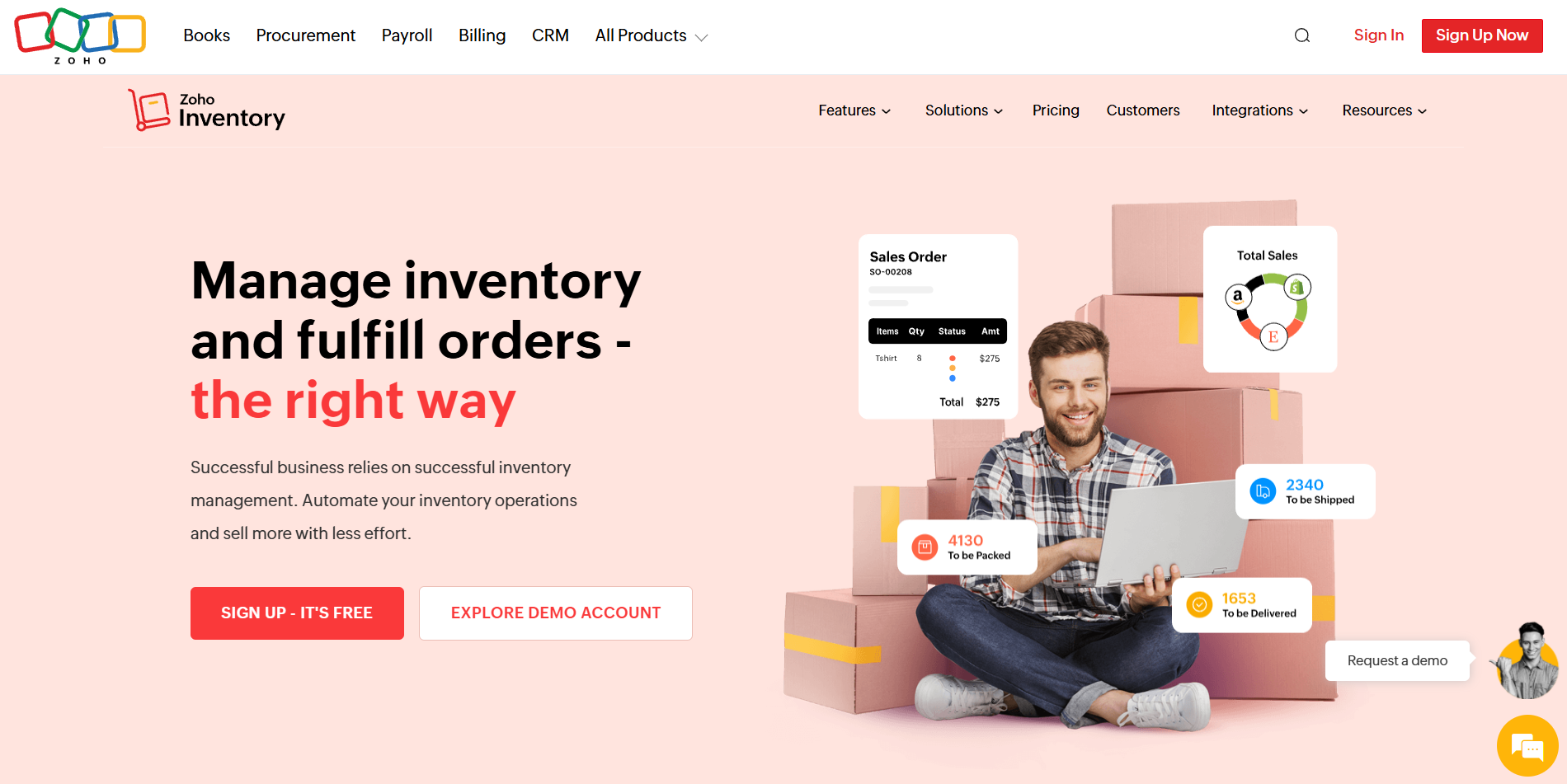
What it does: Zoho Inventory tracks inventory, processes orders, and updates items across Shopify, Amazon, eBay, and Etsy.
Who it’s for: Small, budget-conscious sellers with modest catalogs selling across a few online channels.
I tested Zoho Inventory by updating 100 products across Shopify and Amazon. The updates appeared on both channels within a few minutes, and I didn’t need to manually adjust any listing information.
To assess the tool’s multi-channel order processing, I generated labels through integrated carriers for 10 orders. The system created labels correctly with tracking numbers automatically attached to orders in all channels.
Key features
- Basic warehouse management: Tracks stock across multiple locations and assigns orders to appropriate fulfillment sites.
- Purchase order creation: Manages reordering from suppliers with automated low-stock alerts based on configurable thresholds.
- Multi-channel order management: Consolidates orders from Shopify, Amazon, eBay, Etsy, and other channels into one processing queue.
Pros
- Integrates with Zoho ecosystem: Connects to Zoho Books, CRM, and Analytics for all-in-one business management.
- Straightforward setup process: You can connect channels and start processing orders within a few hours.
Cons
- Slow system: Some users report serious performance and support issues, including broken inventory updates, system drops, and slow support responses in individual cases.
Pricing
Zoho Inventory pricing starts at $39/month per organization.
Bottom line
Zoho Inventory delivers multi-channel management at affordable prices to small sellers.
3. CedCommerce: Best for marketplace integrations
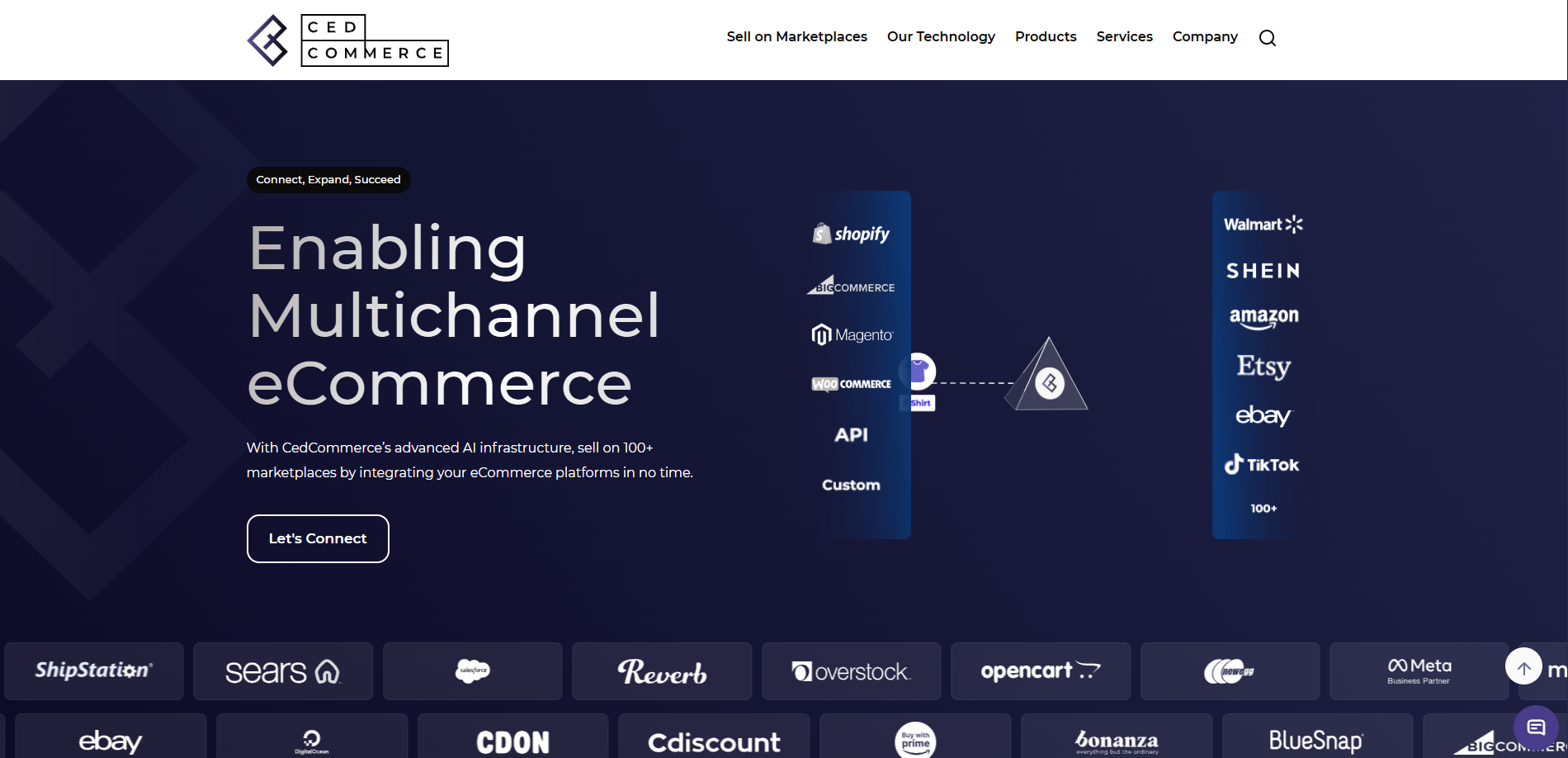
What it does: CedCommerce connects Shopify, WooCommerce, and Magento stores to Amazon, Walmart, eBay, and 100+ international marketplaces.
Who it’s for: Store owners expanding from their webstore to marketplaces who need product data reformatted for platform requirements.
During testing, I uploaded 200 hoodies from Shopify to Amazon using attribute mapping. CedCommerce successfully listed these products in the correct categories, sizes, and variants.
I tested the ordered update feature, sending goods from Walmart back to Shopify. Orders appeared in Shopify within minutes, and customer details and line items populated correctly.
Key features
- Attribute mapping interface: Matches store product fields to marketplace requirements with templates for common categories.
- Bulk product upload: Pushes entire catalogs to marketplaces in batches with error reporting for failed listings.
- Order centralization: Imports marketplace orders into your store platform for unified fulfillment and customer management.
Pros
- Integration-specific features: Builds marketplace-specific tools like Amazon advertising management or eBay promoted listing controls.
- Dedicated support per integration: Provides marketplace specialists who understand platform policies and technical requirements.
Cons
- Marketplace‑specific apps: Many CedCommerce integrations are sold as separate marketplace apps, often with their own subscription.
Pricing
Fill out a form on CedCommerce’s homepage to schedule a demo and receive a custom quote.
Bottom line
CedCommerce gets your products onto marketplaces quickly through proven integrations. It’s a valuable tool if expanding channels matters more than building workflow automations.
4. Listing Mirror: Best for listing management workflows
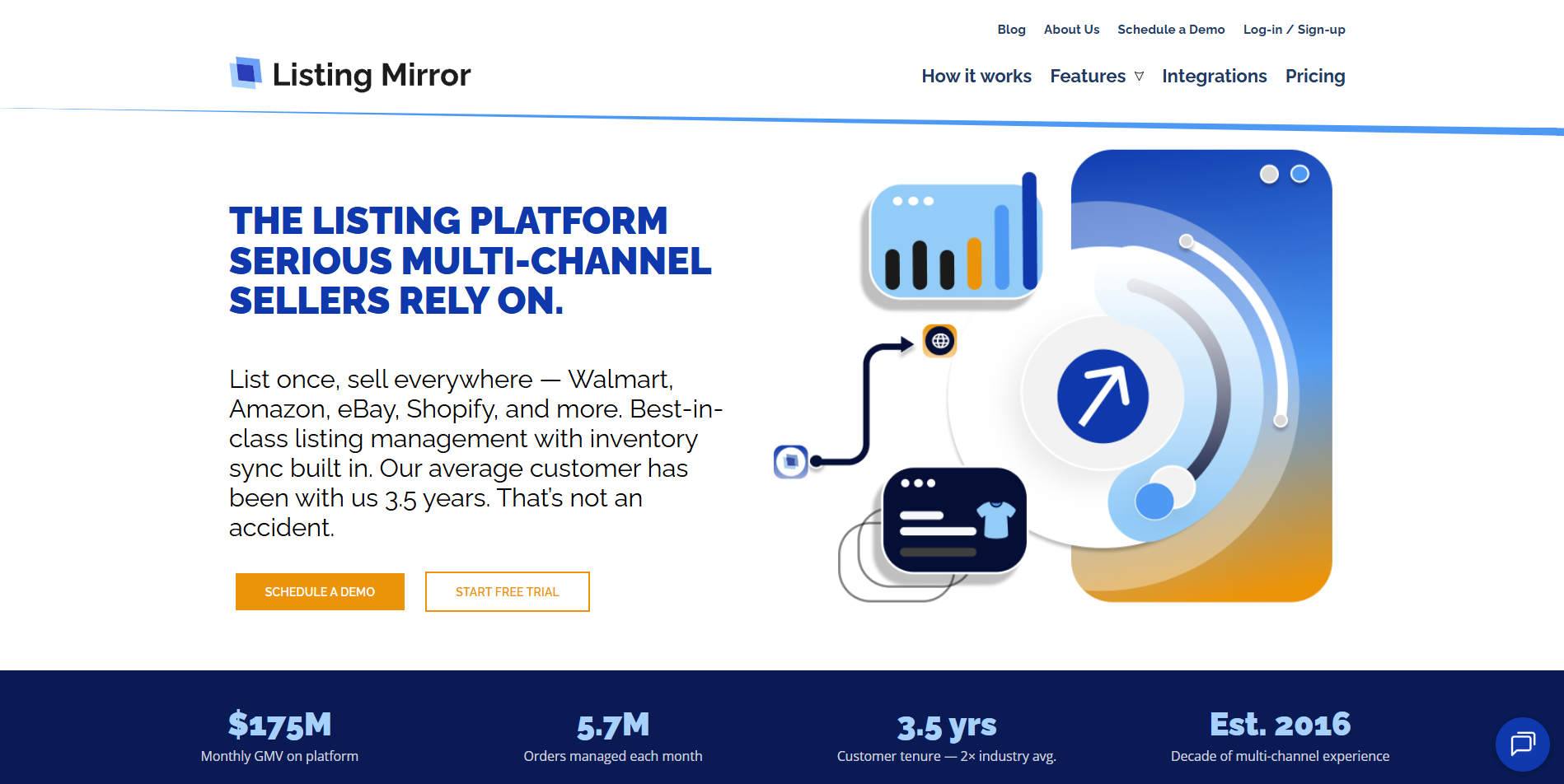
What it does: Listing Mirror
Best for: Sellers focused on getting products listed quickly across multiple channels.
Where it stands out
The tool offers strong listing creation and duplication tools with solid real-time inventory updating and order management.
Pricing
Listing Mirror pricing starts at $69/month.
5. Multiorders: Best for simple channel uploading
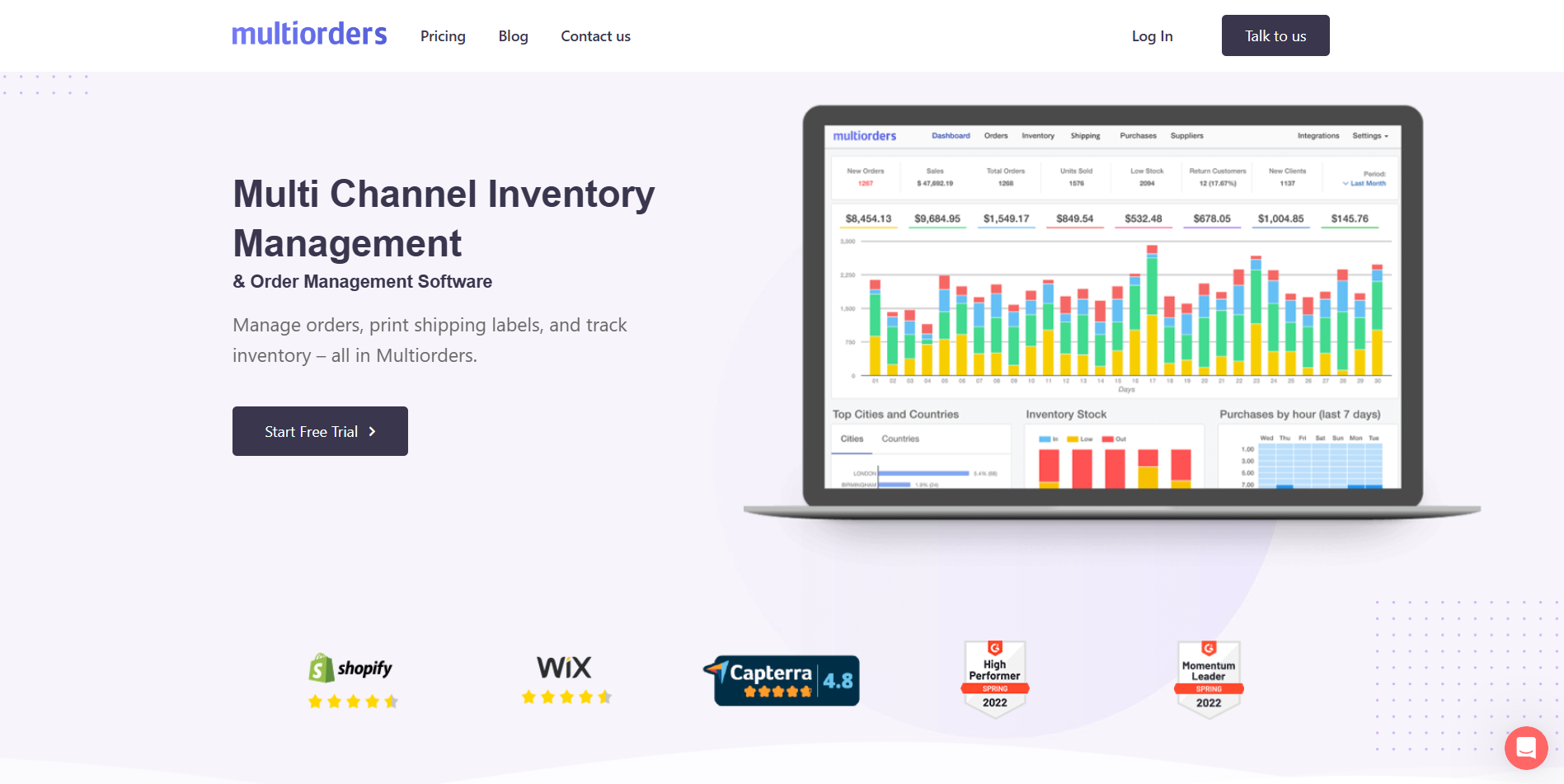
What it does: Multiorders consolidates orders and updates inventory across Amazon, eBay, Etsy, and major webstores.
Best for: Sellers needing straightforward multi-channel inventory bulk uploading without complexity.
Where it stands out
Multiorders offers a clean interface with fast setup, but minimal automation or advanced warehouse features.
Pricing
Multiorders pricing starts at $64/month.
6. SellerActive: Best for repricing-focused sellers
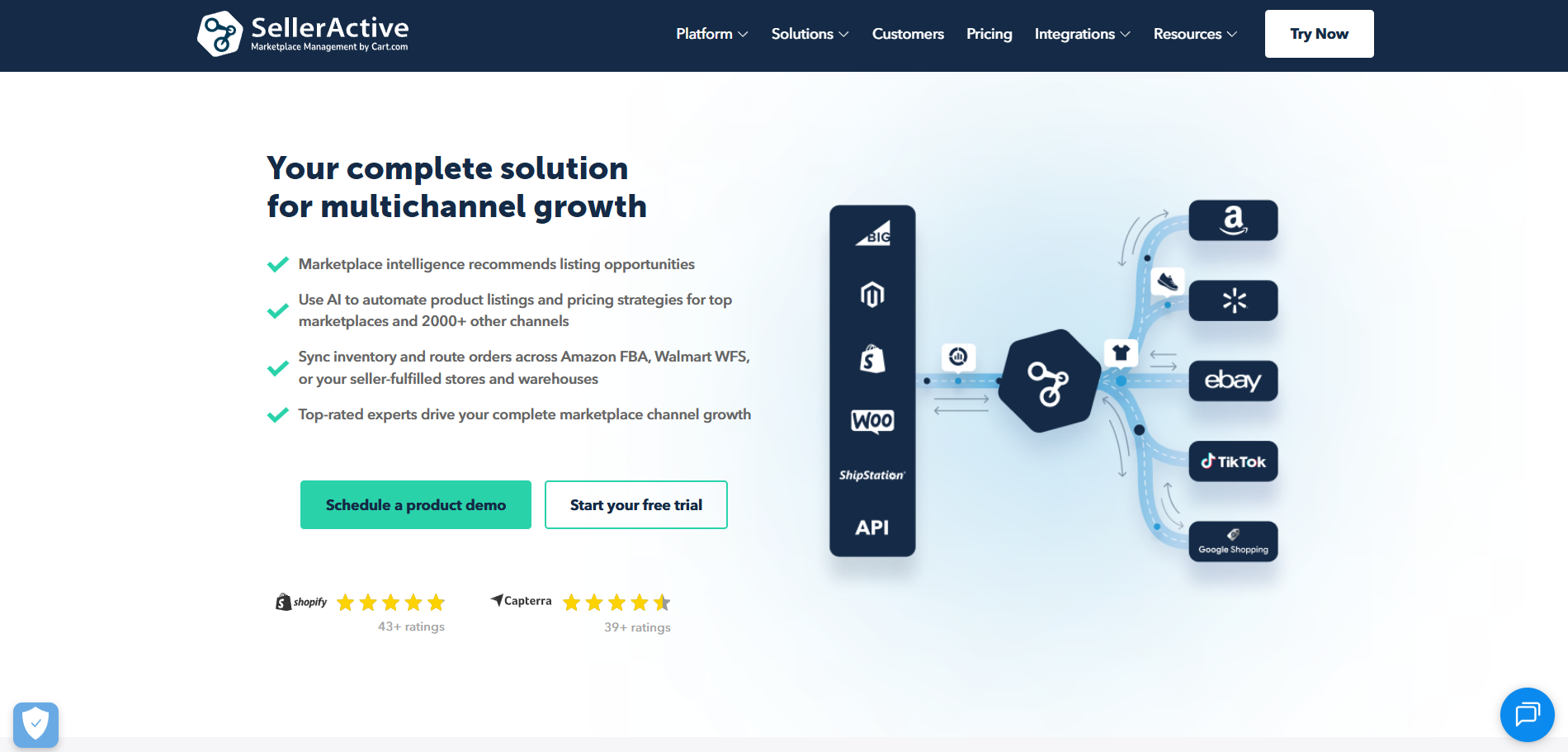
What it does: SellerActive adjusts prices automatically across marketplaces based on competitor pricing and business rules.
Best for: Sellers competing on price across Amazon, eBay, and Walmart.
Where it stands out
It offers an advanced repricing engine with competitor tracking, which helps you set accurate prices.
Pricing
SellerActive pricing starts at $99/month.
7. QuickBooks Commerce: Best for inventory accounting integration
What it does: QuickBooks Commerce integrates inventory transactions directly into QuickBooks for automated financial tracking and cost calculations.
Best for: The tool suits existing QuickBooks users selling across multiple channels.
Where it stands out
Its native QuickBooks functionalities eliminate manual accounting entries for inventory and cost of goods sold.
Pricing
QuickBooks Commerce pricing starts at $19/month.
8. Base: Best for European marketplace sellers
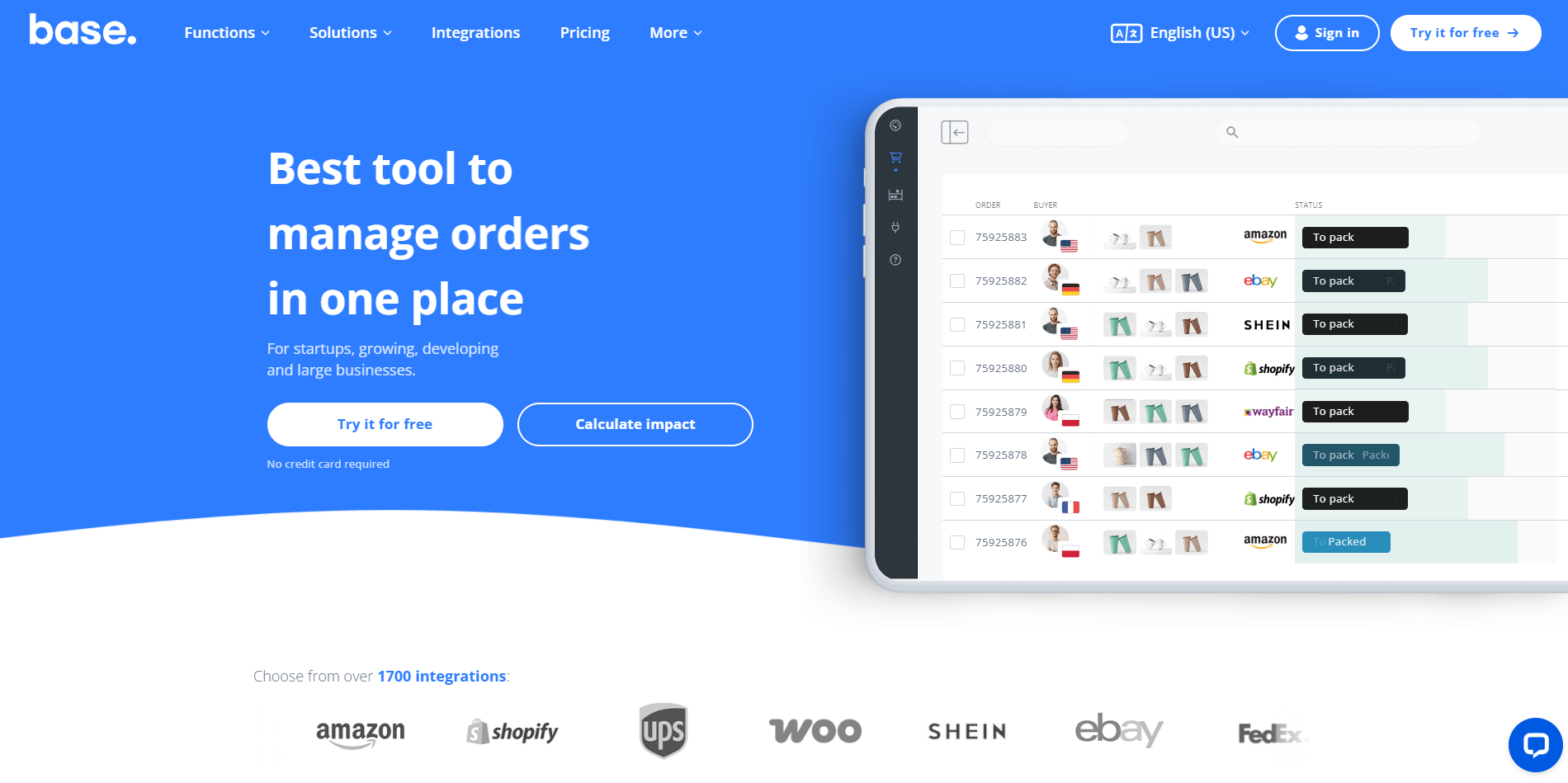
What it does: Base manages inventory, orders, and purchasing for European retailers with marketplace integrations and accounting exports.
Best for: European sellers managing inventory and orders across regional marketplaces.
Where it stands out
Offers native integrations that eliminate manual accounting entries for inventory and cost of goods sold.
Pricing
Base pricing starts at $39/month.
Resellers’ crosslisting and automation
9. Nifty: Best resellers’ multi-channel e-commerce software
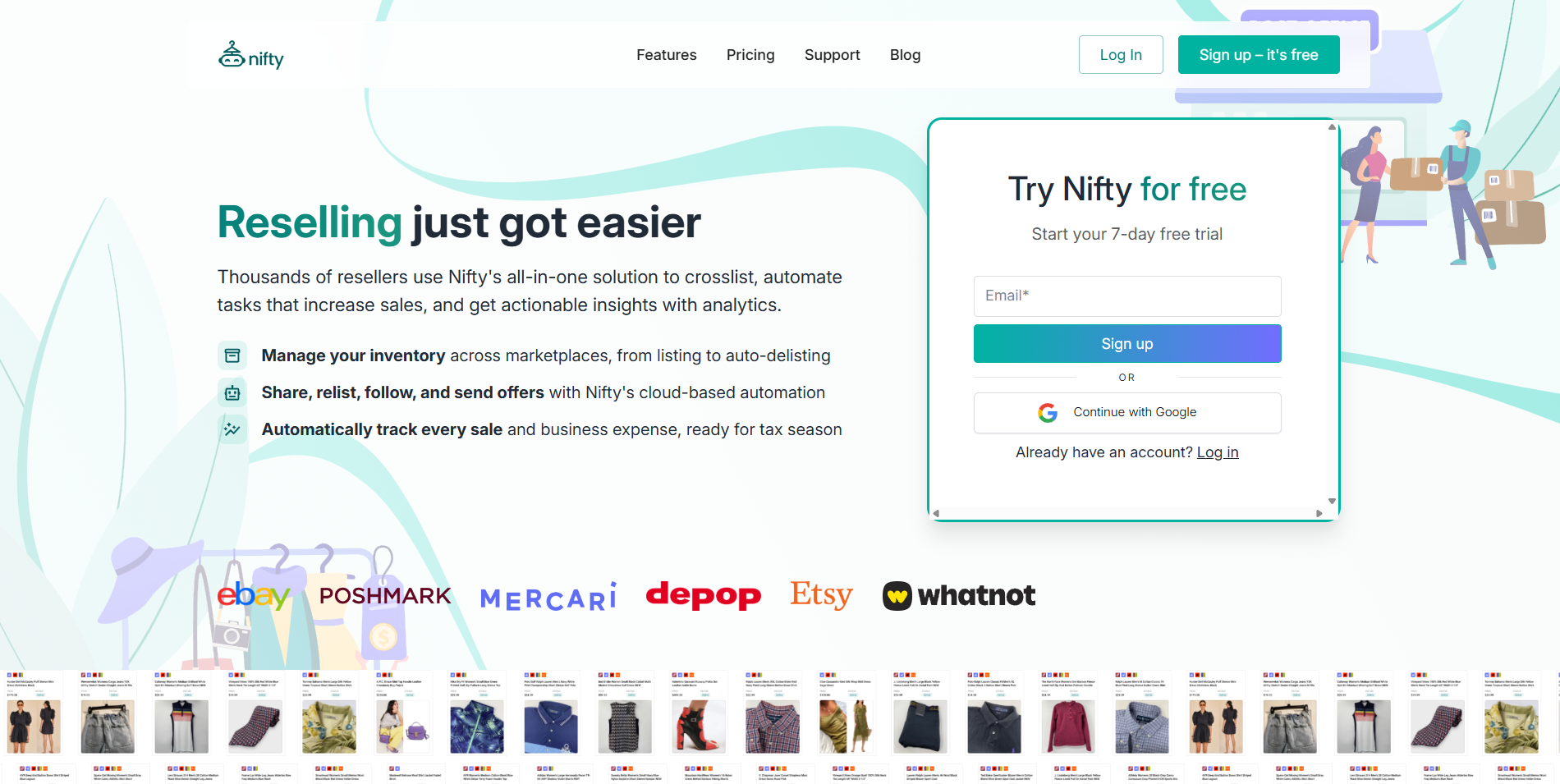
What it does: Nifty automates relisting, delisting, and sharing. It crosslists and bulk uploads items across multiple marketplaces.
Best for: Resellers of all sizes, managing listings across multiple marketplaces who relist and share listings daily.
Nifty, our own multi-channel e-commerce software, solves the problem many resellers and e-commerce businesses encounter: Juggling separate apps for listing, sharing, and bookkeeping.
We built Nifty to centralize users’ entire reselling operations. The result is that inventory, automations, and analytics actually work together in one convenient command center.
For example, Nifty goes beyond automating simple Poshmark shares. Every day, Nifty shares my Poshmark listings to likers on my pre-set schedule. Nifty’s pre-set limits let me rest easy because they’re automatically set to stay within Poshmark’s daily guidelines.
And whenever I have new inventory, Nifty’s AI generates SEO-optimized titles, listings, and tags, all ready to publish.
Key features
- Cross-platform inventory uploads: Manages one master inventory list that you can bulk update and edit across eBay, Poshmark, Etsy, Depop, and Mercari (more marketplaces in the mix!).
- Automatic delisting: Deletes sold listings across all marketplaces.
- Analytics and profit tracking: Reports sales data and takes fees into account to generate profit and loss reports.
Pros
- Runs in the cloud: Automations run on Nifty's servers, so tasks complete even when your devices are off.
- Respects platform policies: Enforces Poshmark's 60-day relist minimum and 8,000 daily shares, as well as Depop’s 100 automatic relists per day rule.
Cons
- Feature-heavy: Nifty offers analytics, automation, crosslisting, and even photo tools, so you’ll need to take time to learn the platform.
Pricing
Nifty’s pricing starts at $25/month for Poshmark and eBay automation and $39.99/month for crosslisting. Save 12% with the annual plan.
The bottom line
Nifty offers a top-tier reselling platform with crosslisting features, cloud automation, AI-driven tools, and in-depth performance analytics.
10. Vendoo: Best for beginner resellers

What it does: Vendoo crosslists items across 11 marketplaces, including Poshmark, eBay, Mercari, Depop, Etsy, Facebook Marketplace, Grailed, Shopify, Vinted, Whatnot, and Vestiaire Collective, with import tools and basic inventory tracking.
Best for: New resellers managing under 200 items who want an affordable entry point into multi-marketplace selling without complex automation.
I tested Vendoo by importing 40 existing eBay listings and crossposting them to Poshmark, Mercari, and Depop. Listings appeared on each platform within a few minutes, but I had to click-to-confirm each match manually, which slowed bulk imports as the count climbed.
To test sale detection, I sold a hoodie on Poshmark and watched Vendoo auto-delist the item from eBay, Mercari, and Depop within 10 minutes. However, auto-delisting only works on 6 of the 11 supported marketplaces, so I had to manually pull items sold on Facebook Marketplace, Etsy, and Grailed.
Key features
- Multi-marketplace crosslisting: Posts items to 11 platforms from one dashboard, though base plans cap you at 3 marketplaces without paid add-ons.
- Native mobile apps: iOS and Android apps let sellers list, edit, and track inventory from their phones, though Capterra reviewers mention glitches and certain edits that only work on desktop.
- Inventory and profit tracking: Logs sales, marketplace fees, and item costs to calculate profit broken down by category and brand.
Pros
- Low entry cost: The $8.99/month starter plan gives part-time sellers a way to test crosslisting before committing to a higher tier.
- Wide marketplace coverage: Connects to niche platforms like Vestiaire Collective, Vinted, Grailed, and Whatnot that many competitors skip.
Cons
- Limited automation reach: Sale detection only covers 6 of 11 marketplaces, AI listing generation requires you to first describe photos manually (no photo-to-listing automation). The dashboard slowed noticeably as I added more listings.
Pricing
Vendoo's pricing plans start at $8.99/month for 25 listings, with the $69.99/month tier being the most popular plan among active resellers.
Bottom line
Vendoo gives beginner resellers an accessible entry point for managing smaller inventories. It works well for sellers who prioritize low cost and broad marketplace coverage, but limited automation means more manual work as your business scales.
11. List Perfectly: Best for resale marketplace integration

What it does: List Perfectly copies listings across Poshmark, Mercari, eBay, Depop, and other resale platforms.
Best for: Individual resellers crossposting unique items to multiple marketplaces.
Where it stands out
The crosslisting and automation tool focuses entirely on listing distribution and Poshmark automation.
Pricing
List Perfectly pricing starts at $29/month.
12. Crosslist: Best for fast listing duplication
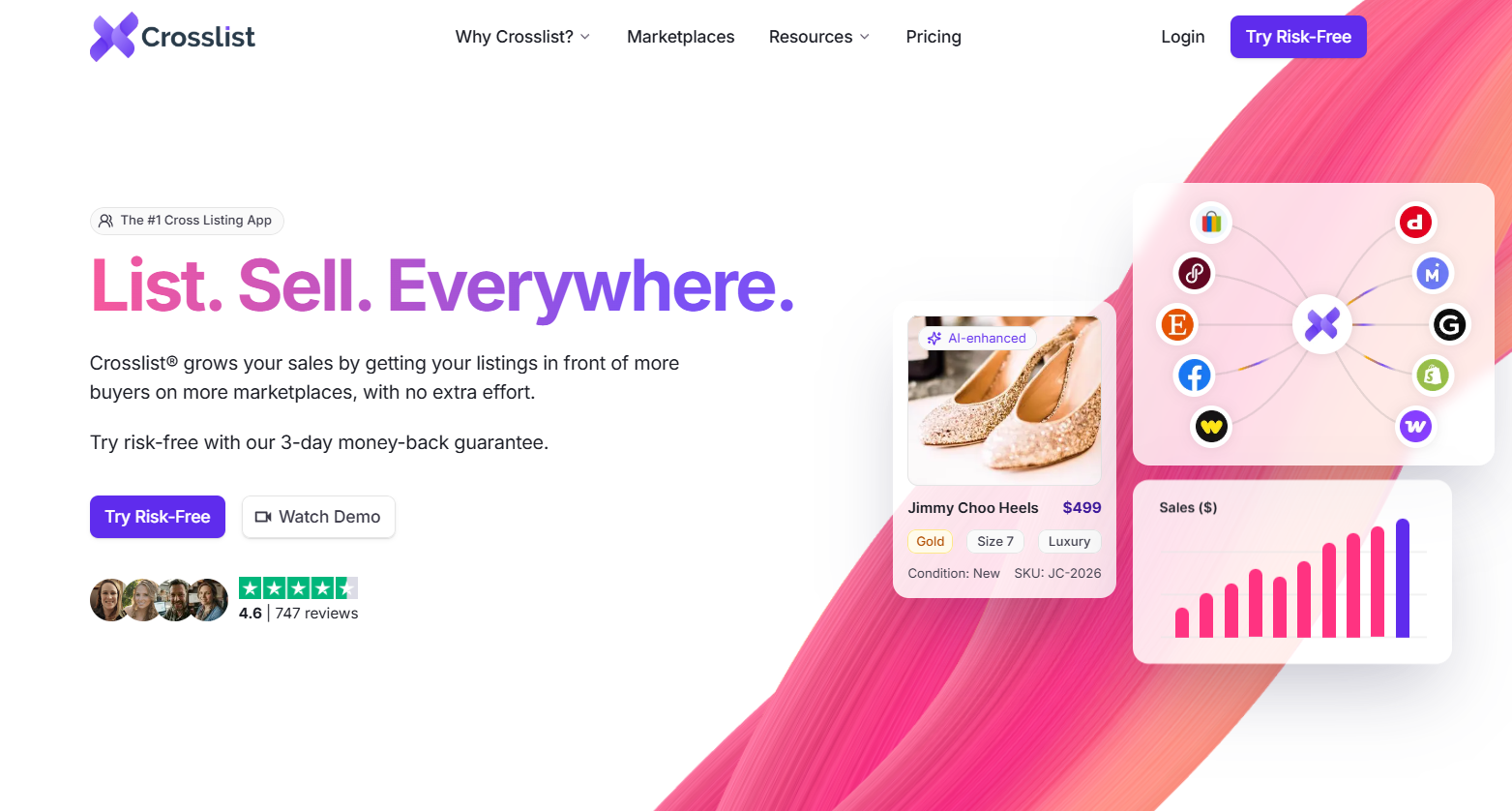
What it does: Crosslist copies listings across 11+ marketplaces (Poshmark, Mercari, eBay, Depop, Grailed, Facebook Marketplace, etc.) with one-click crossposting and bulk relist/delist tools.
Best for: Resellers needing quick listing distribution and bulk management without deep inventory tracking or order fulfillment.
Where it stands out
It offers fast AI-powered listing creation (generate details from images), bulk crossposting to 11+ marketplaces, and simple dashboard management. But it doesn’t provide order management, fulfillment, or shipping features.
Pricing
Crosslist’s pricing plans start at $29.99/month.
Mid-market warehouse ops
13. Extensiv (formerly Skubana): Best for high-volume brands

What it does: Extensiv unifies inventory, order routing, purchasing, and operational reporting across marketplaces and channels.
Best for: Brands processing thousands of orders monthly across multiple channels with complex fulfillment and purchasing workflows.
I tested Extensiv’s intelligent order routing across 2 warehouse locations with 200 orders using distance-based rules. The tool automatically assigned orders to the closest fulfillment center, with backup location routing when stock ran low.
Next, I assessed the automated purchase order (PO) generation feature using sales and lead times for 50 SKUs. The system automatically created POs when inventory hit reorder points and adjusted quantities with my forecasted demand.
Key features
- Smart order routing: Assigns orders to fulfillment locations for inventory, shipping speed, costs, or custom business rules.
- Multi-location inventory tracking: Maintains real-time stock counts across warehouses, third-party logistics (3PLs), and retail locations with transfer management.
- Automated purchasing workflows: Generate purchase orders from sales history, reorder points, and supplier lead times.
Pros
- Handles complex fulfillment networks: Supports mixed fulfillment models with direct warehouses and drop-ship suppliers simultaneously
- Integrates with 3PL and shipping tools: Connects to 3PL partners and platforms like ShipStation and Stamps.com for automated routing and tracking.
Cons
- Steep learning curve: Configuring routing rules, forecasting parameters, and financial tracking requires substantial operations knowledge and setup time.
Pricing
Contact Extensiv’s team by visiting the homepage and scheduling a demo to get a custom quote.
Bottom line
Extensiv justifies its complexity and cost when fulfillment operations become a bottleneck. The tool delivers routing intelligence and financial visibility that volume sellers need but don't get from simpler platforms.
14. Linnworks: Best for inventory-heavy sellers
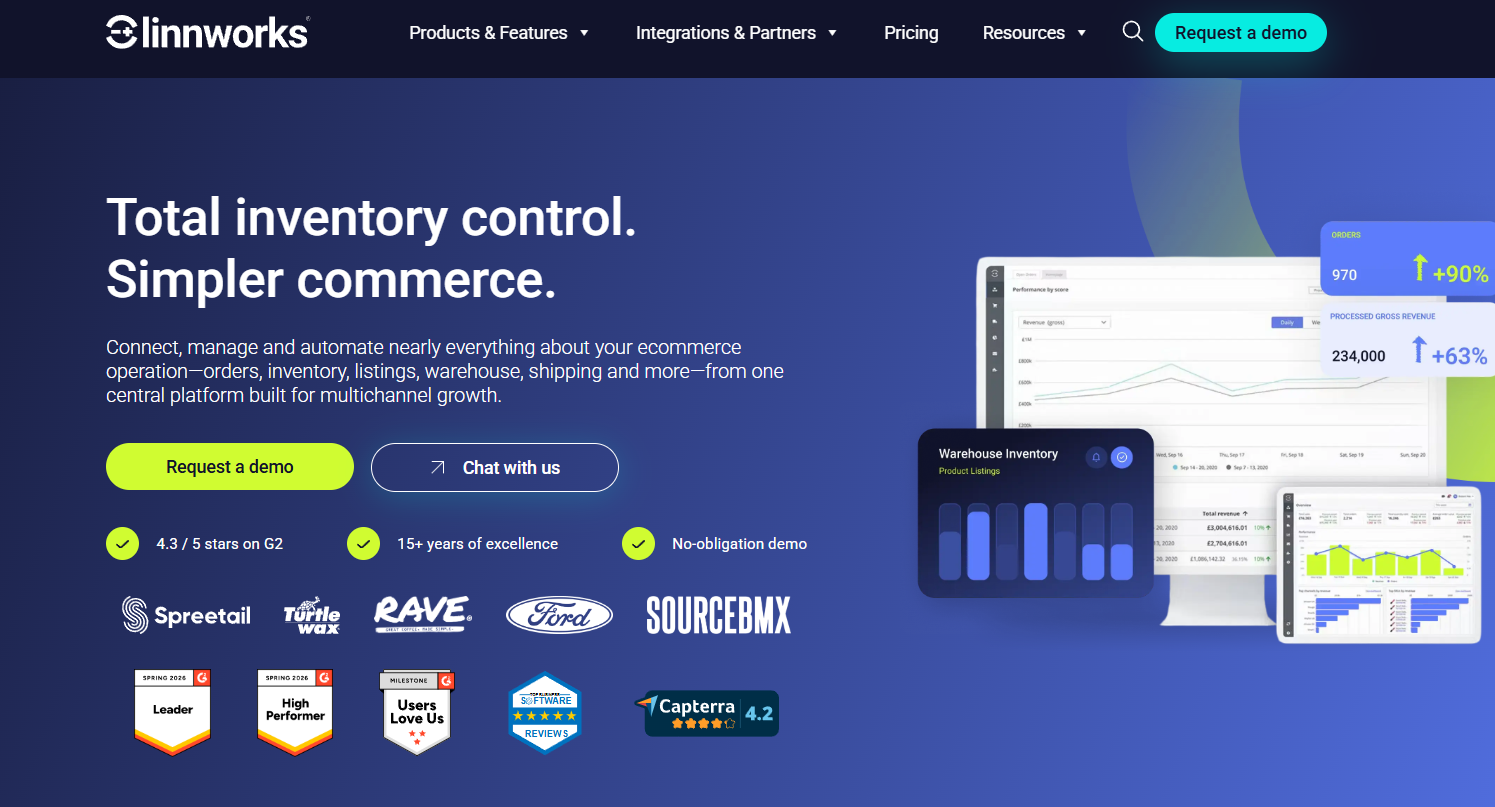
What it does: Linnworks centralizes inventory tracking, order processing, and warehouse management across marketplaces, webstores, and fulfillment locations.
Who it’s for: Sellers with large, complex SKU catalogs across multiple warehouses and several sales channels.
To test Linnworks, I allocated inventory across Walmart, Amazon, and eBay, and the platform split my goods between two warehouse locations. Orders routed to the correct warehouse based on available inventory, and I didn’t need to make any manual adjustments.
I tested batch order processing with automated shipping label generation for 50 orders. The tool printed my labels in sequence, and all contained correct rates and tracking numbers.
Key features
- Batch shipping label creation: Generates labels for multiple carriers in one workflow with rate shopping across services.
- Stock forecasting tools: Projects reorder points from sales data and lead times from suppliers.
- Returns management system: Processes returns, restocks inventory, and triggers refunds or exchanges based on configurable workflows.
Pros
- Handles complex inventory structures: Tracks bundles, kits, and component relationships so orders decrement all related SKUs.
- Integrates with shipping carriers: Connects directly to USPS, UPS, FedEx, and regional carriers for real-time rates.
Cons
- Interface feels dated: Navigation requires multiple clicks to reach common tasks compared to modern inventory platforms.
Pricing
Contact Linnworks’ team to get a custom quote.
Bottom line
Linnworks organizes inventory across multiple warehouses and channels at scale. It can deliver productivity gains once you learn how to configure its complex operations.
15. Sellercloud: Best for complex catalogs
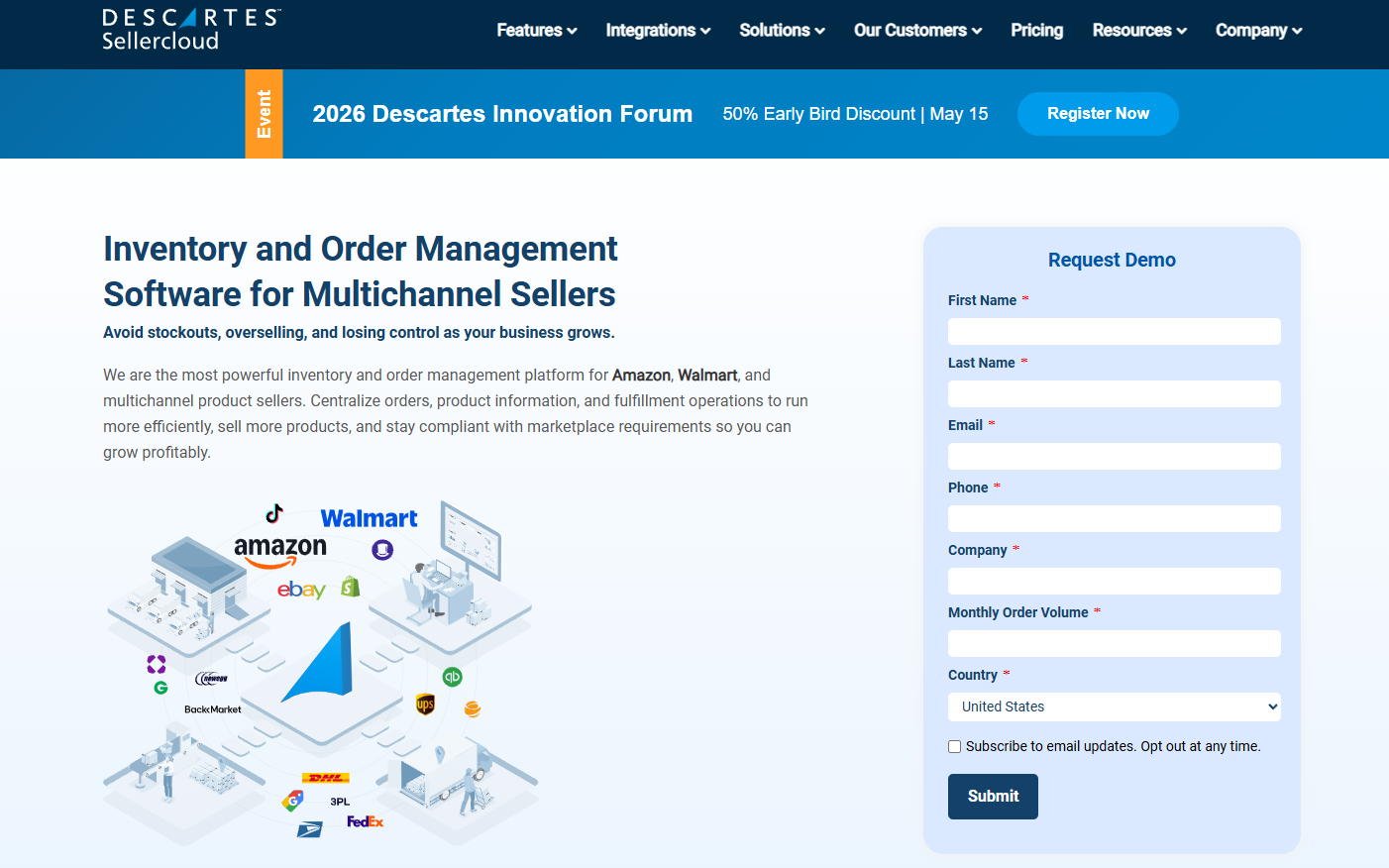
What it does: Sellercloud manages products with multiple variants, bundles, and kits across marketplaces and webstores.
Best for: Sellercloud suits sellers managing products with extensive variant structures or bundled components.
Where it stands out
Handles complex product relationships like matrix variations and multi-component kits reliably.
Pricing
Sellercloud pricing starts at $1,349/month.
16. Orderhive: Best for lightweight inventory management
What it does: Orderhive tracks inventory and processes orders across Amazon, eBay, Etsy, and webstores.
Best for: Small sellers needing basic multi-channel bulk uploads for under 500 SKUs.
Where it stands out
It offers a simple interface with quick setup and solid automation for common workflows, though it offers fewer capabilities than enterprise platforms.
Pricing
Orderhive pricing plans start at $299/month.
Enterprise and ERP
17. Rithum: Best for enterprise retailers

What it does: Rithum updates inventory, pricing, and orders across Amazon, Walmart, eBay, and 420+ marketplaces and retailer sites.
Best for: Brands and retailers with large catalogs on major marketplaces needing centralized inventory, pricing, and order automation.
I tested Rithum’s bulk price adjustments across Amazon and Walmart using percentage-based rules for 500 SKUs. Price changes updated to both marketplaces within 15 minutes, with full audit logs.
To evaluate the tool’s order routing rules, I directed oversized items to a specific warehouse using packaging dimensions. Orders meeting the criteria routed correctly and generated pick lists with the designated fulfillment location.
Key features
- Dynamic repricing rules: Adjust prices with competitor data, stock levels, or margin requirements.
- Marketplace content optimization: Formats product titles, descriptions, and attributes to meet each platform's listing standards.
- Order management routing: Directs orders to warehouses or drop-ship suppliers by following configurable business rules.
Pros
- Scales with catalog size: Designed to support very large SKU counts across many channels for enterprise brands.
- Supports complex fulfillment logic: Routes orders by inventory location, shipping speed requirements, or product attributes.
Cons
- Learning curve: Mapping product data and configuring rules are complex, often taking weeks for automations to run correctly.
Pricing
Contact Rithum for a custom quote.
Bottom line
Rithum offers advanced channel management for large e-commerce and dropshipping operations, making it a great choice for enterprises.
18. Brightpearl: Best for retail operations

What it does: Brightpearl connects inventory, orders, and accounting across online channels and physical retail locations.
Best for: Retailers running both brick-and-mortar stores and online sales channels.
Where it stands out
The tool has built-in accounting and POS integration for unified omnichannel retail operations.
Pricing
Contact Brightpearl for a custom quote.
19. NetSuite ERP: Best for enterprise commerce operations
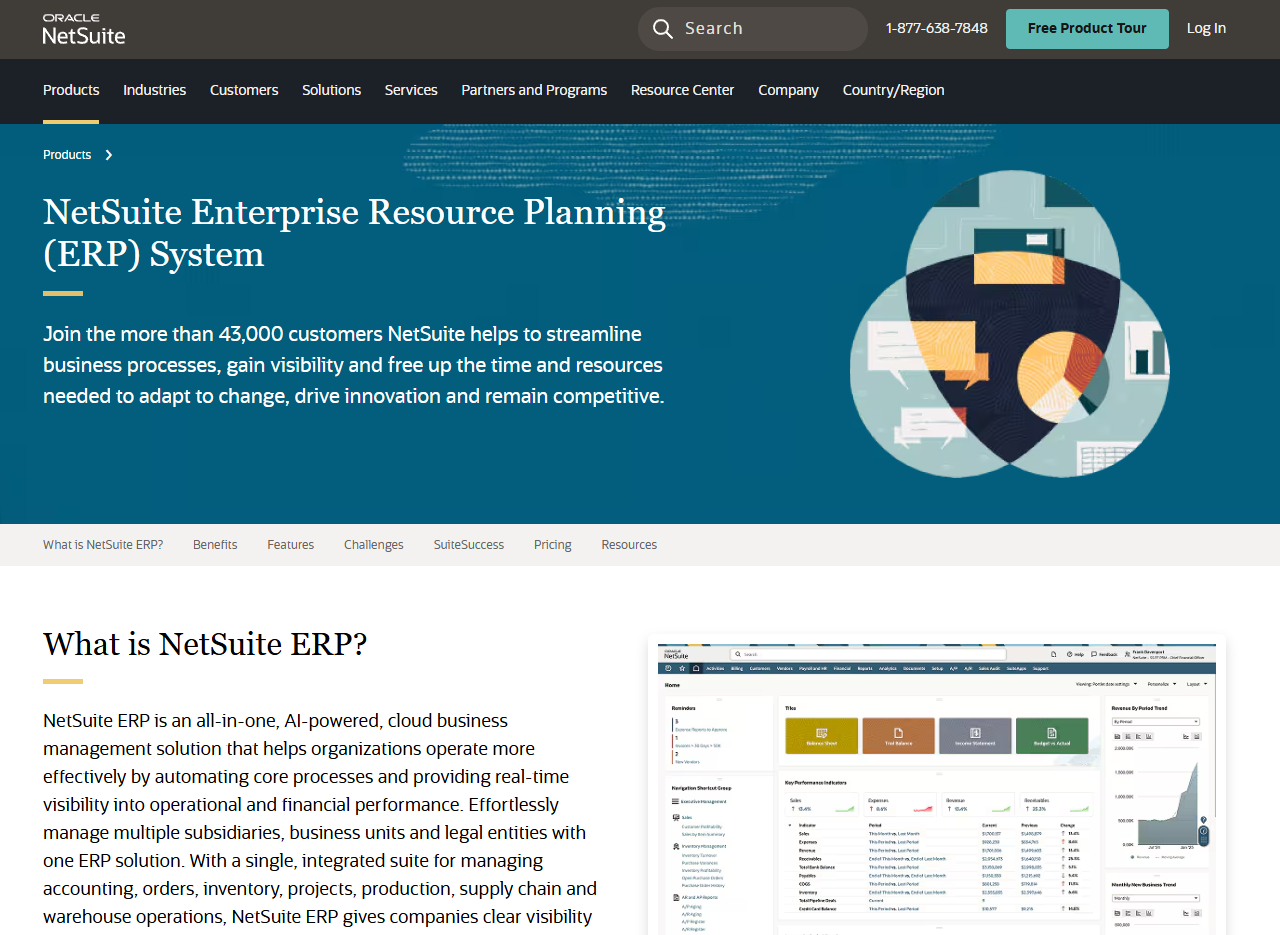
What it does: NetSuite ERP integrates e-commerce, inventory, financials, and operations into a single enterprise resource planning system.
Best for: Large organizations that need integrated business management beyond just multi-channel sales.
Where it stands out
The tool offers ERP functionality with e-commerce modules but requires major implementation investment and ongoing maintenance.
Pricing
To get NetSuite ERP custom pricing, request a free product tour on the homepage.
20. Mirakl: Best for marketplace operators

What it does: Mirakl builds and operates third-party seller marketplaces similar to Amazon or eBay models.
Best for: Retailers launching their own marketplace platforms with third-party sellers.
Where it stands out
The tool is mainly for marketplace creation rather than connecting to existing marketplaces like other multi-channel tools.
Pricing
Contact Mirakl’s sales team for a custom quote.
21. Shoppingfeed: Best for product feed syndication
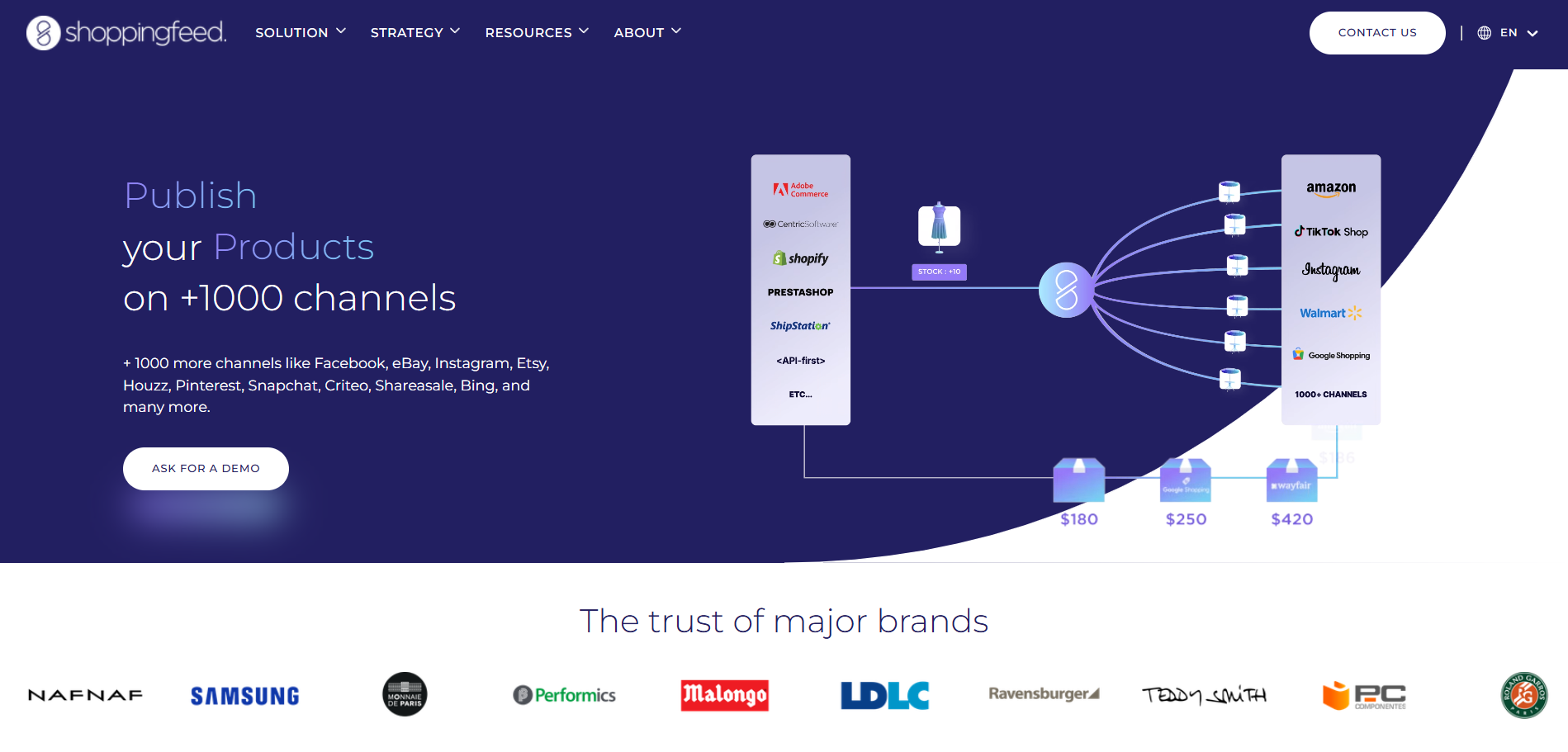
What it does: Shoppingfeed distributes product feeds to marketplaces, comparison shopping engines, and advertising platforms automatically.
Best for: Brands distributing product catalogs to 1,000+ channels, including Google Shopping, Facebook, marketplaces (Amazon, eBay, Etsy, Walmart), social platforms, comparison engines, and advertising networks.
Where it stands out
Strong feed optimization, product data enrichment, and multi-channel distribution across 1,000+ channels, but doesn’t provide fulfillment, order management, or warehouse operations features.
Pricing
Contact the Shoppingfeed team to receive a custom quote.
22. Odoo: Best for open-source ERP stacks
What it does: Odoo combines e-commerce, inventory, accounting, and CRM in modular open-source business software.
Best for: Businesses wanting customizable, integrated systems with technical resources available.
Where it stands out
The tool offers open-source flexibility with complete business modules but requires developer expertise and ongoing maintenance.
Pricing
Odoo’s pricing starts at $24.90/user per month.
Storefront builders
23. Shopify Plus: Best for DTC brand scaling

What it does: Shopify Plus powers direct-to-consumer stores with built-in marketplace connections and wholesale channel management.
Best for: Large brands prioritizing their own store with marketplace sales as secondary channels.
Where it stands out
You’ll get enterprise-grade performance, Shop Pay checkout, headless commerce support, and omnichannel/B2B capabilities, with marketplace integrations available via apps.
Pricing
Shopify Plus pricing starts at $2,500/month.
24. BigCommerce: Best for multi-storefront businesses
What it does: BigCommerce manages multiple branded stores with shared catalog and marketplace channel connections.
Best for: Brands running separate storefronts for different audiences or regions.
Where it stands out
The tool offers native multi-storefront architecture (on the enterprise tier) with marketplace integrations and shared catalog management.
Pricing
Contact the BigCommerce team and schedule a demo.
25. WooCommerce: Best for custom e-commerce builds
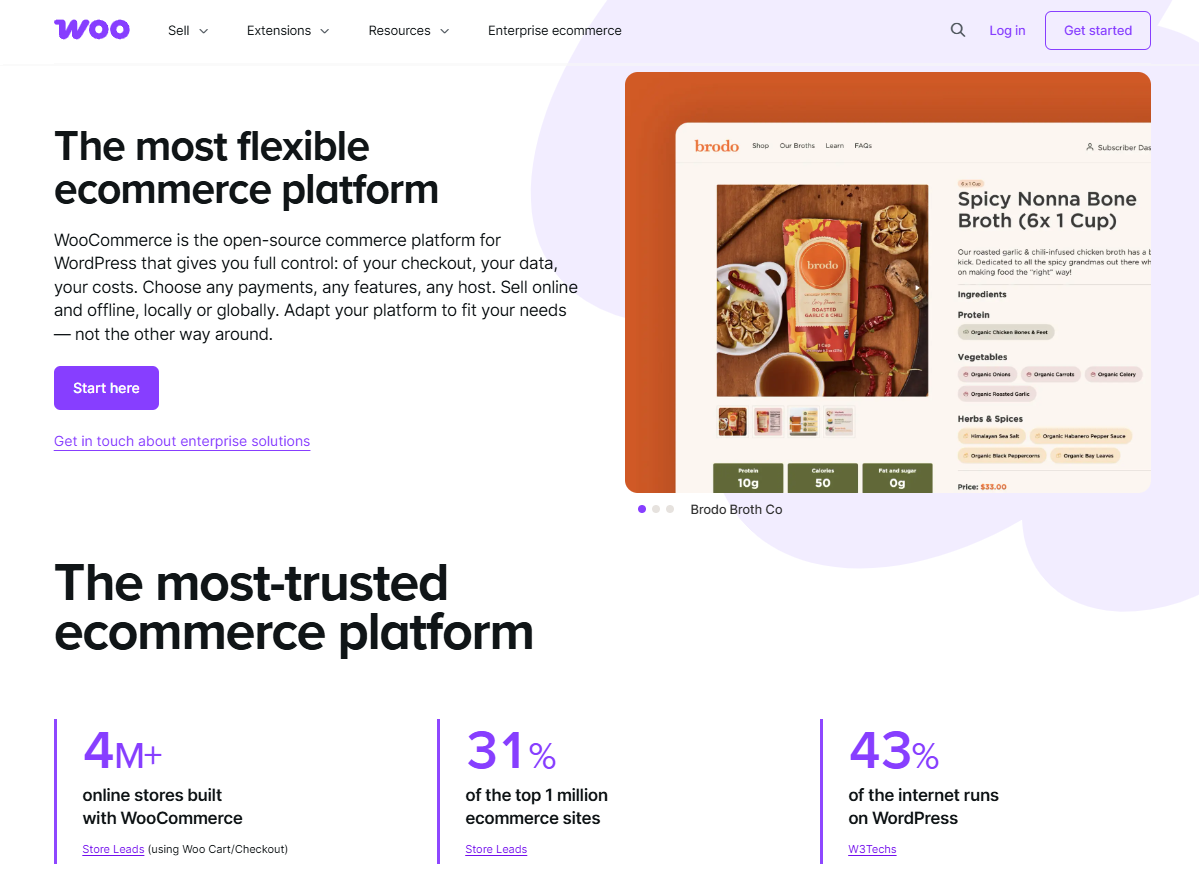
What it does: WooCommerce adds e-commerce functionality to WordPress sites with marketplace connections through third-party extensions.
Best for: Businesses needing complete control over store customization and data ownership.
Where it stands out
It’s an open-source platform with unlimited customization, but requires technical resources and plugin management.
Pricing
WooCommerce has a free core plugin. But you’ll need to cover hosting, marketplace integration plugins ($50 to $300/year), and potential development fees.
26. Squarespace Commerce: Best for content-driven stores

What it does: Squarespace Commerce provides online stores with built-in design tools and limited marketplace channel connections.
Best for: E-commerce sellers who prioritize beautiful storefronts over extensive marketplace distribution.
Where it stands out
Strong design templates and content integration, but limited native marketplace integrations focus on owned storefronts, social selling, and POS rather than Amazon, eBay, or Walmart channels.
Pricing
Squarespace Commerce pricing starts at $25/month.
Shipping and fulfillment
27. ShipStation: Best for shipping-centric operations
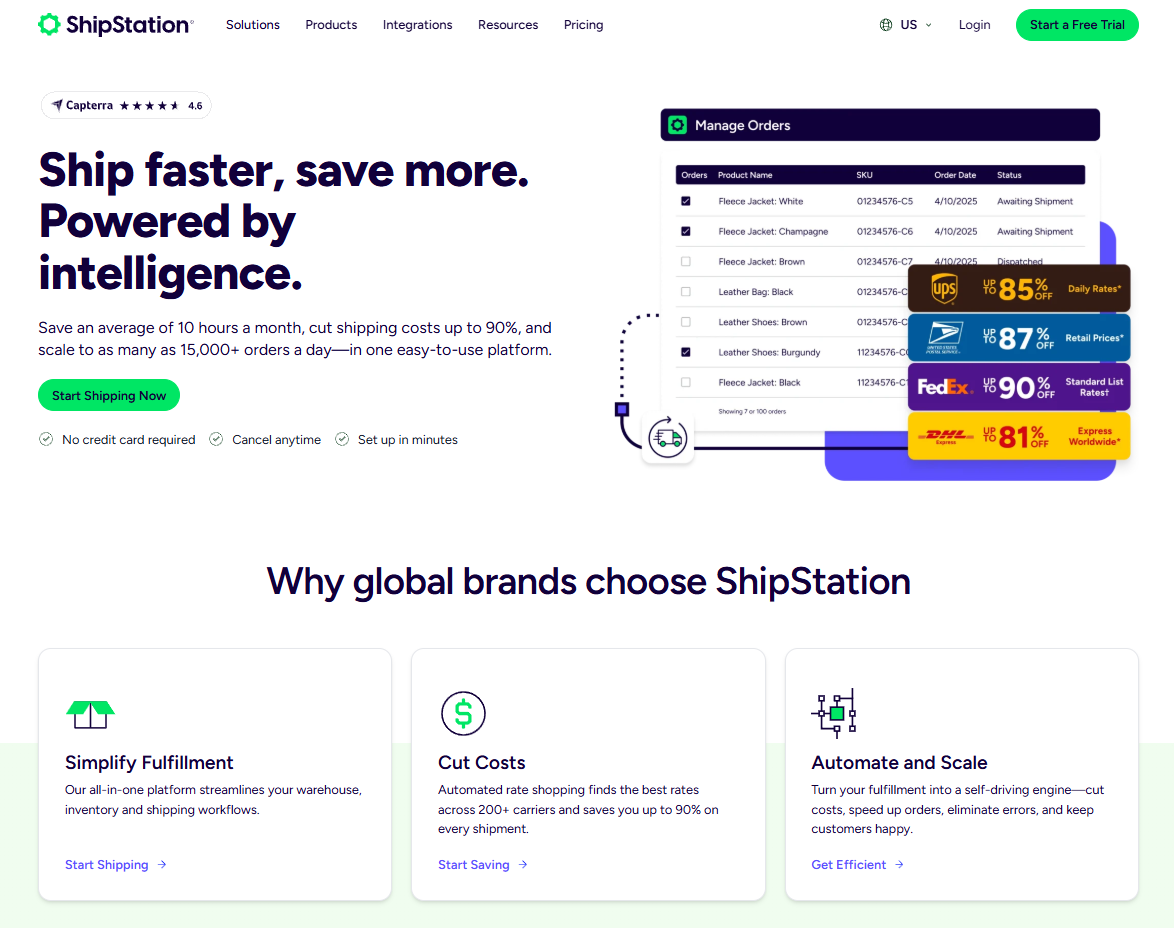
What it does: ShipStation centralizes orders from all channels for bulk shipping label creation and tracking updates.
Best for: High-volume shippers processing hundreds of daily orders across channels.
Where it stands out
The shipping tool automates advanced shipping workflows and carrier integration, but offers minimal inventory management or listing features.
Pricing
ShipStation pricing starts at $14.99/month.
28. ShipBob: Best for fulfillment-led brands

What it does: ShipBob connects channels to ShipBob's fulfillment network for automated picking, packing, and shipping.
Best for: Brands outsourcing fulfillment across multiple sales channels and geographies.
Where it stands out
The tool combines 3PL fulfillment and a software platform but requires using ShipBob's warehouse network.
Pricing
Contact the ShipBob team to get customized pricing.
29. Veeqo: Best for Amazon-led sellers
What it does: Veeqo, owned by Amazon, updates inventory and ships orders across Amazon, eBay, Shopify, and other channels.
Best for: Sellers doing the majority of their revenue through Amazon, with secondary channels.
Where it stands out
Free shipping software with deep Amazon integration owned by Amazon.
Pricing
Veeqo offers a free trial, after which pricing starts at $19/month.
Hidden costs of managing multiple marketplaces
Most sellers focus on listing fees and shipping costs, but real expenses show up in these areas:
- Manual inventory count problems: Manual reconciliation can eat 30 to 60 minutes daily because tools don’t update platforms accurately. Always get a tool that accurately updates inventory across connected platforms.
- Duplicate sales burn twice: A buyer on Poshmark purchases your vintage tee while someone on eBay clicks “Buy It Now” for the same item 15 minutes later. You refund one buyer, apologize profusely, and watch your seller rating drop because you oversold inventory.
- Price changes multiply effort: Dropping prices for a weekend sale means logging into each connected platform to manually edit each listing. Get a tool that lets you bulk-update prices so you can make updates in one place.
- Order fulfillment differences: Poshmark orders need prepaid USPS labels, while eBay lets you choose carriers, and Mercari generates its own shipping codes. You should use a tool that accurately updates inventory across connected platforms.
My final verdict: Which multi-channel e-commerce software should you choose?
Each of these 29 multi-channel e-commerce software platforms solves specific problems for different seller types and business models. Here's how to match your operation with the right tool:
Choose Sellbrite if you ...
Manage a few dozen monthly listings across Amazon, eBay, and Shopify, and want unified order management without complexity.
Choose Rithum if you ...
Run an enterprise brand with 500+ SKUs across Amazon, Walmart, and other channels.
Choose Nifty if you ...
Resell across Poshmark, eBay, Mercari, Depop, Whatnot, and Etsy, and need AI-powered listing creation and cloud-based automation tools.
Choose Zoho Inventory if you ...
Run a small, budget-conscious operation selling across Shopify, Amazon, eBay, and Etsy.
Choose Extensiv if you ...
Process thousands of monthly orders across multiple channels with complex fulfillment networks.
Choose ShipStation if you ...
Process hundreds of daily orders across channels and need bulk shipping label creation.
Manage listings on multiple platforms with Nifty
After reviewing 29 multi-channel e-commerce software options, the decision comes down to finding a platform that actually reduces workload instead of adding more steps to your day.
If you're managing listings across multiple marketplaces, Nifty consolidates crosslisting, automation, and analytics into one cloud-based interface designed specifically for resellers.
Here's why Nifty's so helpful:
- AI listing: Snap a pic and let Nifty's AI build a high-quality listing, with SEO-optimized titles and descriptions, and trending hashtags filled out for you. Plus, it runs in the cloud, it’s mobile-friendly, and easy to use.
- Crosslist now: With a couple of clicks, post your items across Poshmark, eBay, Mercari, Depop, Whatnot, and Etsy. No copy-paste, and no multi-tab chaos. (More marketplaces coming soon!)
- Automatic delisting? Handled: When you make a sale, Nifty's sales-detection auto-delists the item from every marketplace. Say goodbye to double-selling disasters and "sorry, it's already gone" apology messages.
- Bulk tools = no busywork: Share and relist daily with just a few clicks. Update or discount dozens of items at once. You can even schedule drafts to go live while you sleep.
- Analytics and profits are real: Track sales, fees, top performers, and slow movers in one clean dashboard, so you can actually see what's working and what's just dead space.
Nifty pays for itself in just a few weeks. So … what are you waiting for? Start with a 7-day free trial and see how Nifty simplifies multi-channel selling.
FAQs
1. What is multi-channel e-commerce software?
Multi-channel e-commerce software includes tools that let you manage inventory, listings, orders, and analytics across multiple online marketplaces from one dashboard. Instead of logging into each marketplace separately, multi-channel software centralizes product updates, price changes, and sold-item delistings across all supported platforms.
2. Do I need multi-channel e-commerce software if I already sell on marketplaces?
Yes, multi-channel e-commerce software is highly recommended if you sell on two or more marketplaces. These tools greatly reduce the manual work of updating listings and tracking inventory, and help reduce double sales. Most multi-channel tools automate crosslisting and inventory updates, and many also offer automatic delisting and built-in analytics.
3. What problems does multi-channel e-commerce software actually solve?
Multi-channel e-commerce software helps prevent overselling by auto-delisting or adjusting inventory when items sell on one platform. It significantly reduces manual inventory updates across marketplaces and reduces pricing errors during sales by centralizing price changes. These tools can also consolidate orders from different channels into a single workflow.


.png)
.png)
.png)