
Depop vs. Poshmark: Comparison & how I sell on both (2026)

By selling on both platforms, I’ve learned that the biggest difference is that Depop's lower fees beat Poshmark’s high fees. Poshmark has a larger user base in North America, but Depop has an easier listing process. Here’s a quick rundown comparing Depop vs. Poshmark:
| Category | Depop | Poshmark |
|---|---|---|
| Users | 56.3 million users, 150 countries | 130 million users, North America |
| Buyer audience | Gen Z buyers, vintage streetwear focus | Mixed ages, brand-focused North Americans |
| Fees | 3.3% + $0.45 processing fee (U.S.) | $2.95 under $15; 20% commission over $15 |
| Payout timing | 2 days after delivery confirmation | After order acceptance, or 3 days after delivery |
| Listing photos | Up to 8 photos per listing | Up to 16 photos plus video |
| AI listing tools | AI descriptions, mobile English markets | Smart List AI, iOS photo analysis |
| Shipping | Seller options, Depop labels available | $6.49 flat label, prepaid shipping |
| Returns | Limited returns; often seller-friendly disputes | Strict returns; typically favors sellers |
| Selling features | Social feed selling, aesthetic branding | Posh Shows live selling, auctions |
How do Depop and Poshmark compare?
Poshmark and Depop are online marketplaces where people sell clothing, shoes, and fashion accessories. The platforms share social selling features, like following other sellers and liking listings.
Both apps also show social feeds that highlight items you recently searched for or new listings from people you follow. But these platforms have differences.
Depop shows a simple feed with items from sellers you follow and listings similar to what you’ve searched for. The platform attracts many Gen Z buyers who look for vintage, Y2K, streetwear, and unique pieces. It has over 56.3 million registered users and serves around 150 countries.
Although it centers around a social feed, Poshmark feels like a traditional resale marketplace. Buyers often search for well-known brands, athleisure, and everyday clothing, and listings appear in a clean, catalog-style format. Poshmark has over 130 million users across North America.
Poshmark’s social features go beyond following, listing, and liking: You can host live-stream shows where viewers bid on listings.
The bottom line
Depop suits fashion and accessory sellers targeting younger buyers and lets you keep more money from sales.
Poshmark is a strong fit for fashion and accessory sellers who want to reach a broad audience and use live-stream shopping features to connect with buyers in real time.
Depop vs. Poshmark: Fees and payouts
Both Depop and Poshmark take different approaches to fees and payouts. Fees directly affect your profit, so you’ll need to know what each platform takes from every sale. You’ll also need to know when each platform’s payout actually hits your bank account so you can plan cash flow.
Fees and payouts overview
| Marketplace | Depop | Poshmark |
|---|---|---|
| Fees | No platform fee; 3.3% + $0.45 processing (U.S.); 2.9% + £0.30 (U.K.) | $2.95 flat (sales under $15); 20% commission (sales $15+); No separate processing fee |
| Fee calculated on | Item price + shipping | Item price only |
| Payout trigger | 2 business days after confirmed delivery, or 10 days post-sale, whichever comes first | Buyer accepts order; or automatically 3 days post-delivery |
| Withdrawal | Direct to bank (2–5 business days after release) | Via Poshmark balance → direct deposit, mailed check, or Poshmark credit |
Depop fees and payouts
Depop only charges U.S. sellers a 3.3% + $0.45 payment processing fee on every transaction and U.K. sellers a 2.9% + £0.30 per order. Sellers from other countries pay a 10% marketplace fee plus payment processing fees, which are typically around 2.9% plus $0.30 per transaction.
The marketplace calculates fees based on the total transaction amount plus shipping.
U.S. sellers receive payment 2 business days after the buyer confirms delivery, or 10 days after the sale, whichever comes first. After Depop releases the payout, it usually takes 2 to 5 business days for the money to hit your bank account.
Poshmark fees and payouts
Compared to Depop, Poshmark takes a much higher fee: The platform charges a flat $2.95 fee on sales under $15 and a 20% commission on sales over $15. Poshmark doesn’t charge listing or separate payment processing fees.
Sellers receive payment after the buyer accepts the order or automatically 3 days after delivery. The earnings appear in the seller’s Poshmark balance, and the seller must redeem the balance to withdraw funds through direct deposit, a mailed check, or Poshmark credit.
The winner: Depop
Depop is the clear winner on fees and payouts. U.S. sellers pay just 3.3% + $0.45 per transaction, a fraction of Poshmark's steep 20% commission on sales over $15. Although Poshmark may sometimes pay out faster, Depop’s super-low fees can result in a better bottom line. You’ll just need to sharpen your bookkeeping skills to manage cash flow.
Depop vs. Poshmark: Buyer audience
Poshmark draws shoppers focused on fashion in North America, while Depop attracts a younger, trend-driven audience interested in vintage clothing, streetwear, and Y2K styles.
Depop buyer audience
Depop's audience skews heavily toward Gen Z and younger Millennials:
- They prioritize individuality over basics.
- Depop’s buyers gravitate toward vintage finds, streetwear, and one-of-a-kind pieces that help them stand out.
- High-quality, authentic presentation, and the product matter equally.
- Depop’s buyers will pay a premium for anything with a strong aesthetic.
Poshmark buyer audience
Although Poshmark attracts the same Gen Z and young Millennial buyers, it also has a considerable number of shoppers over age 40.
- Poshmark’s buyers are largely North Americans hunting for clothing, shoes, and accessories.
- Many buyers come to Poshmark to score deals on recognizable and luxury brands like Coach and Louis Vuitton.
- Buyers find listings through search, personalized feeds, and social features.
- Poshmark’s buyers also differ from Depop buyers because they can get to know sellers at live Posh Shows.
The winner: Poshmark
Poshmark wins because it reaches a broader buyer demographic (130 million+) and provides additional features for sellers to connect with buyers, like Posh Live shows. Depop performs well for niche styles like vintage and streetwear, but Poshmark’s wider audience and brand-focused demand give sellers access to a larger pool of potential buyers.
Depop vs. Poshmark: Listing process
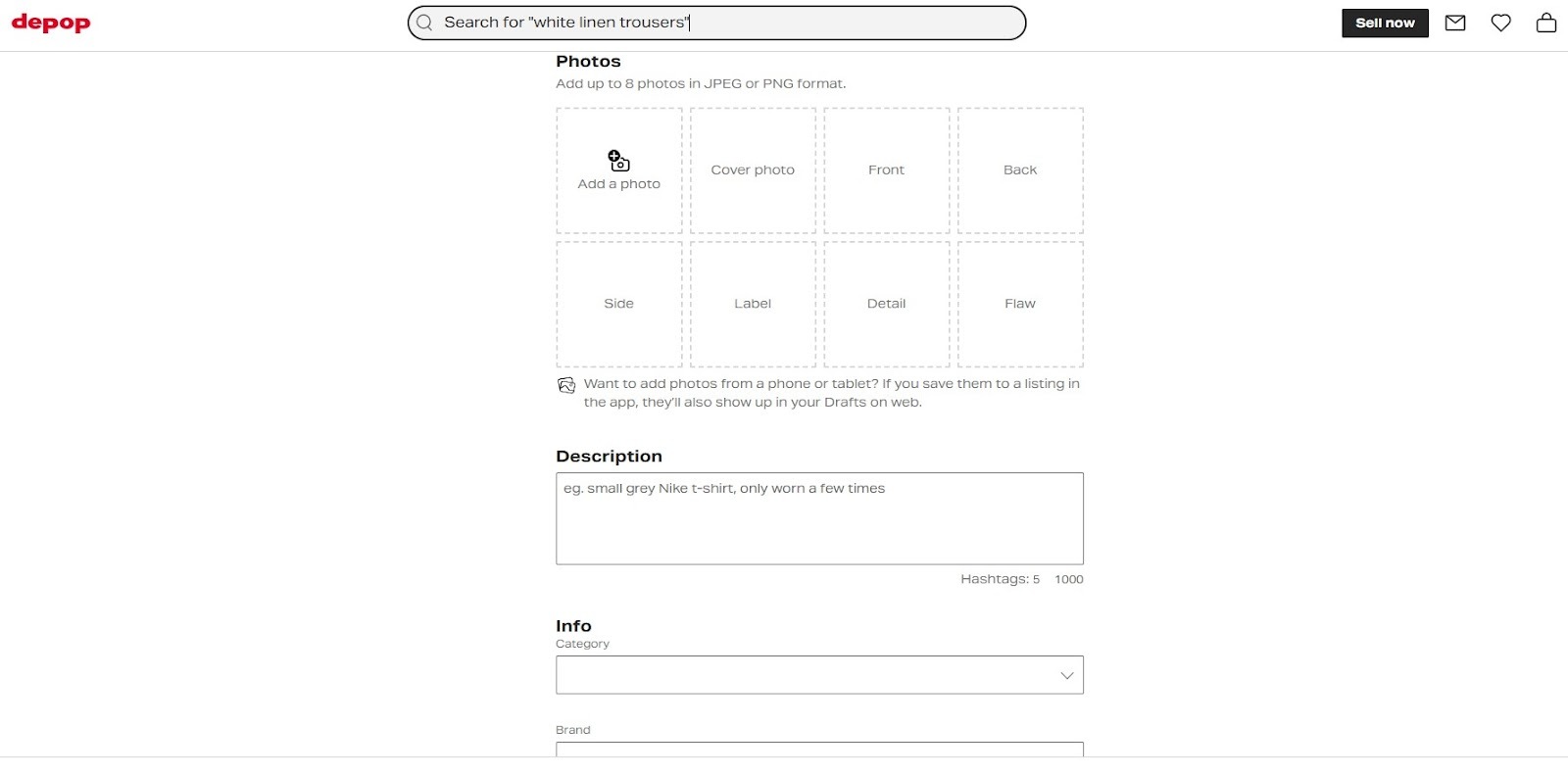
The listing process comes down to the time and effort required to publish an item. This process spans from uploading photos to entering details and setting a price. While both Poshmark and Depop keep listing simple, they differ in a few key ways.
Listing process overview
| Marketplace | Depop | Poshmark |
|---|---|---|
| Photos/media | Up to 8 photos | Up to 16 photos + video |
| Key listing fields | Description, hashtags, price, shipping, drop-down enhancement tags | Description, category, brand, size |
| AI tools | AI description generator (available in limited regions) | Smart List AI: mobile iOS only |
| Listing speed | Faster: minimal fields, AI-assisted | Moderate: more fields, AI limited to iOS |
Depop listing process
Depop keeps the listing process simple. Sellers upload up to 8 photos, add a description with up to 5 hashtags, set a price, and choose a shipping option. You can also “enhance” your listing with drop-down tags for color, source, age, and style.
The marketplace also offers an AI description generator that Depop built into the app, but it’s currently available to mobile users in English‑speaking countries (e.g., U.S., U.K., Australia, Canada, and Ireland).
You can upload one photo to create a draft description and auto-fill details like category, color, and brand. Sellers can review the information, adjust the description, and publish the listing in a few taps.
Poshmark listing process
Poshmark lets you upload up to 16 photos (plus a video), write a description, and fill in details like category, brand, and size. The listing flow focuses on fashion and accessories, making it a relatively fast platform for getting items live.
If you're a mobile iOS user, Poshmark cuts manual data entry with Smart List AI. This tool analyzes your photos and automatically generates your title, description, category, and key item details from a single image. Then, fix anything that’s off and publish in minutes.
The winner: Depop
Depop wins because its listing process is faster and more straightforward than Poshmark’s.
Depop vs. Poshmark: Shipping and returns
Poshmark keeps shipping simple with flat rates and prepaid labels, but Depop lets sellers choose their own shipping options. Note that shipping costs raise the total price buyers pay.
Return policies also change the level of risk you face as a seller. The two platforms approach disputes differently.
Shipping and returns overview
| Category | Depop | Poshmark |
|---|---|---|
| Shipping model | Flexible: seller chooses their own option; labels available via Depop Shipping | Flat-rate prepaid USPS labels included |
| Shipping cost | Varies by method | $6.49 (up to 5 lb); $11.49 (5.1–10 lb); $16.49 (10.1–15 lb) |
| Free shipping & tracking | Seller may offer free shipping; tracking required regardless of method | Seller may choose to cover; tracking included with prepaid label |
| International shipping | Supported | North America only |
| Returns accepted | Item not received; significantly not as described;No change-of-mind returns | Damaged, misrepresented, missing parts, or counterfeit;No sizing or change-of-mind returns |
| Dispute handling | Seller-managed | Poshmark reviews and manages |
Depop shipping and returns
Depop gives you three main shipping options:
- Use Depop Shipping and charge the buyer: Depop Shipping provides printable prepaid USPS labels and tracking support, so you don’t need to calculate rates manually.
- Offer free shipping: You’ll need to book shipping and provide tracking information.
- Arrange shipping and prices on your own: Shop around and set competitive rates to attract buyers. But you’re responsible for booking and providing tracking details.
When it comes to returns, Depop only refunds buyers who haven’t received an item or who received an item that was significantly not as described. Disputes mainly address problems such as items not arriving, arriving damaged, or not matching the listing description.
Just like Poshmark, Depop generally doesn’t allow change-of-mind returns.
Poshmark shipping and returns
Poshmark charges a flat $6.49 rate for shipping packages up to 5 lb.
Packages weighing 5.1 to 10 lb require a $5 upgrade, which brings the total shipping cost to $11.49. Those weighing 10.1 to 15 lb add $10, increasing the total shipping price to $16.49. Poshmark supports shipping only within North America.
Sellers may choose to cover shipping.
Poshmark applies a strict return policy that generally favors sellers. Buyers can request a return only if the item arrives damaged, differs from the description, arrives with missing parts, or is counterfeit. The platform doesn’t accept returns for sizing issues or regret after purchase.
Disputes still occur when listings lack clear photos or accurate descriptions. Poshmark reviews each claim by comparing the item received with the details shown in the original listing.
The winner: Poshmark
Poshmark wins on shipping and returns for most sellers. Its flat $6.49 prepaid label removes the guesswork.
What real users are saying
I searched Trustpilot and Reddit to gather buyer and seller feedback:
Depop pros
✅ A buyer noted that Depop provided fast and courteous support when handling a return. (March 11th, 2026)
✅ One Depop user enjoys buying and selling on Depop, praising the platform’s smooth experience and dependable support team. (March 3rd, 2026)
✅ On Reddit, a seller said that fall and winter are very profitable seasons for selling on Depop. (March 12th, 2026)
Depop cons
❌ A seller complained about a buyer who threatened to take them to court for a refund. (March 11th, 2026)
❌ A user reported a frustrating support experience, claiming incorrect responses and a closed case without any resolution. (February 13th, 2026)
❌ One user received multiple unexpected charges after entering bank details, forcing them to close both their Depop and bank accounts. (March 10th, 2026)
Poshmark pros
✅ A longtime Poshmark user said they’ve had a consistently positive shopping experience with friendly sellers and dependable item quality. (December 21st, 2025)
✅ A buyer complimented Poshmark for its broad range of designer products, reasonable prices, and reliably quick shipping experiences. (January 27th, 2026)
✅ A first-time buyer highlighted an easy signup, simple ordering process, and a carefully packaged item that matched the description. (October 8th, 2025)
Poshmark cons
❌ One user expressed anger at Poshmark for allowing inactive sellers, fake listings, and too much sharing. (March 10th, 2026)
❌ A seller explained how a canceled Poshmark order erased listing momentum, forcing them to repost and lose existing likes. (March 11th, 2026)
❌ A user described a frustrating experience with no sales and a misleading transaction involving a crypto processor. (February 5th, 2026)
How to make your choice
Your decision between Depop vs. Poshmark depends on your style and audience. Follow this guide to choose one:
Depop is better for …
- Selling to younger buyers: Depop's user base skews heavily Gen Z and younger Millennials who seek out unique, trend-driven pieces.
- Lower fees: Depop charges U.S. sellers just 3.3% + $0.45 per transaction. If you're moving low-margin items, you can keep more earnings.
- Vintage, streetwear, and Y2K fashion: Buyers come specifically hunting for one-of-a-kind finds, band tees, and rare sneakers.
Poshmark is better for …
- Live selling: Poshmark's Posh Shows let sellers connect with buyers in real time, showcase items, and close sales on the spot.
- Larger audience: With over 130 million users across North America, Poshmark gives your listings far more built-in exposure.
- Selling higher-end items: Poshmark buyers actively search for luxury brands like Louis Vuitton, Coach, and Lululemon at below-retail prices.
My verdict
Both Depop and Poshmark are alike, using similar social selling techniques and catering to a broad, fashion-hunting audience. However, the key differences lie in how much profit you want to keep, the brand prestige of your items, and whether you want to sell live.
If you’re aiming to keep the most profit and sell to younger buyers, go with Depop. But if you sell luxury brands and love being on camera, go with Poshmark.
Don’t choose one: List on both Depop and Poshmark with Nifty
If you still can't choose between Depop and Poshmark, list on both of them, and use Nifty to save time. Nifty is a crosslisting and automation tool that lets you upload all your Depop and Poshmark listings to one central command center. You can edit, delete, and refresh listings on both platforms, all in one place.
Here's why Nifty makes selling on Depop and Poshmark effortless:
- AI listing: Snap a pic and let Nifty's AI build a high-quality listing, with SEO-optimized titles and descriptions, and trending hashtags already filled out for you. Plus, it's cloud-based, mobile and desktop-friendly, and easy to use.
- Crosslist now: With a couple of clicks, post your items across Depop, Poshmark, eBay, Mercari, and Etsy. No copy-paste, no multi-tab mayhem. (More marketplaces coming soon!)
- Automatic delisting? Handled: When you make a sale on either platform, Nifty's sales detection auto-delists that item everywhere else. Say goodbye to double-selling disasters and “sorry, it's already gone” apology messages.
- Bulk tools = no busywork: Share and relist daily with a few clicks. Update or discount dozens of items at once. You can even schedule drafts to go live while you sleep.
- Analytics and profits are real: Track sales, fees, top performers, and slow movers across both Depop and Poshmark in one clean dashboard, so you can see exactly where your items sell best.
Nifty pays for itself in just a few weeks. Start with a 7-day free trial and see how much time you save running Depop and Poshmark together.
FAQs
1. Which platform has lower fees, Depop or Poshmark?
Depop is the clear winner on fees vs. Poshmark. U.S. sellers pay just 3.3% + $0.45 per transaction. On the other hand, Poshmark charges a flat $2.95 fee on sales under $15 and a steep 20% commission on anything over $15.
2. Can I sell on both Depop and Poshmark at the same time?
Yes, you can sell on both Depop and Poshmark at the same time. Crosslisting on both platforms maximizes your reach, putting vintage and streetwear pieces in front of Depop's Gen Z audience while also tapping into Poshmark's 130 million+ North American shoppers. Tools like Nifty make managing both platforms from one place simple.
3. Which platform is better for selling vintage and secondhand clothing?
Depop is better for selling vintage and secondhand clothing, since its Gen Z buyer base actively seeks out unique, aesthetic-driven finds. Poshmark performs better for recognizable brands, luxury items, and everyday fashion, targeting a broader North American audience.



.png)
.png)